Translate

Tuesday, June 13, 2017

Awe-Inspiring Spectacle in Upstate South Carolina


For the first time in 47 years, South Carolina will experience a once-in-lifetime total solar eclipse!  On August 21, 2017, Anderson Jockey Lot will host a viewing of the event as a free public service.  Astrophysicist and veteran total solar eclipse observer, Rick Boozer will provide expert running commentary as the eclipse progresses -- beginning with the more than hour long partial phases and then ending with the short (but spectacular) period of totality.
Assuming clear skies, the Anderson Jockey Lot on U.S. Highway 29 will be the best viewing location of the totality climax along the I-85 corridor with longest totality time in this area of 2 minutes and 40 seconds according to the U.S. Naval Observatory's Solar Eclipse Computer.  Totality for the City of Greenville will be 2 minutes and 10 seconds – fully 30 seconds less.  Spartanburg, at most, will only have several seconds.
Why will the Jockey Lot experience a longer totality than any place else along U.S. Hwy 29?  It is because the very center of the Moon's shadow will pass over that location.  Thus, anything farther north or south of the Jockey Lot along U.S. 29 will experience a shorter totality time.  For instance, even though Green Pond is only a few miles south of U.S. 29 away from the Jockey Lot, totality there will be 8 seconds shorter.
When observing an eclipse’s partial phases, it is important to understand that eye damage can occur if viewed with the unprotected eye.  Normal sunglasses do not filter many harmful solar rays that can injure your eyes during the partial phases.  For the public’s safety, special eclipse sunglasses will be available at the event (while supplies last).  The special glasses will not be needed during totality.
Everyone is welcome to view the eclipse at the Anderson Jockey Lot.  We will attempt to shoot video of the eclipse and, if successful, the footage will be accessible online.
Partial eclipse phases begin at 1:09 PM EDT.  Totality will start at 52 seconds after 2:37 PM EDT and will end at 32 seconds after 2:40 PM.  Late partial phases end at 4:09 PM EDT.
Of course, if the sky is cloudy, the total eclipse will not be seen.  Let’s all cross our fingers for clear skies!
Our thanks to Anderson Jockey Lot owner, Mac McClellion for allowing this public event on his premises.  Special accommodations for campers will be available as described here: https://www.facebook.com/AndersonJockeyLot/posts/1600346250007626
For information contact Rick Boozer by email at topastro@singularsci.com.
The next total solar eclipse in South Carolina won’t happen for another 60 years, so don’t miss the eclipse this August if you can help it!
--- Photo of total solar eclipse by Koen van Gorp and used here with his permission ---



Sunday, November 27, 2016

Automated Astronomical Object Feature Measurer

Want to know the size (in kilometers or miles) of a sunspot, lunar crater, festoon on Jupiter, etc. that you see in a photographic image?  My latest software creation called Automated Astronomical Object Feature Measurer (or AAOFM for short) can quickly and accurately tell you the answer.  The app is offered free for download.


Designed to run on Windows, Linux and Mac computers.  Note: This is a beta version and I need feedback concerning any bugs that may exist in the app.  I have installed and run the software successfully on Windows and Linux computers; therefore, input from Mac users would be especially appreciated.
Click the image below to go to my website and choose the menu option to the left labeled  Automated Astronomical Object Feature Measurer to go to the appropriate download area.

http://singularsci.com/

Saturday, November 5, 2016

ATTENTION ALL DOB OWNERS WHO DON'T HAVE A COMPUTERIZED OBJECT LOCATOR

You may already have a computerized object locator and not know it! That is, if you have the right kind of tablet or smartphone. It must have an e-compass in it as well as GPS capability and use the Android operating system.

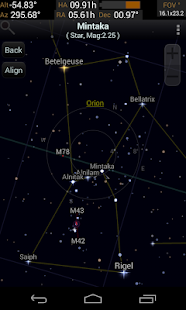
For over a year, I have been using the free astronomy app SkyEye in my outdoor public outreach astronomy presentations. Last night, I finally got around to using one feature in the app that few people have heard of. I just laid my Asus tablet on a Dobsonian telescope (sticking it on with Velcro) belonging to my friend Jesse Willard. I then told the app when the scope was pointed at each of two calibration stars. From that point on, when I wanted to go to a deep sky object, the tablet would tell me how to turn the telescope to get to the object. Sure, enough when the tablet said I had reached the Coat Hanger cluster, there it was in the eyepiece. Next, M27 the Dumbbell Nebula -- again in the eyepiece's field of view. I stopped at that point because I had forgotten to bring my jacket and was getting too cold.


Go here to download the app (image from SkyEye download page)A display from SkyEye:


Wednesday, September 7, 2016

Crossplatform version of AltiSight app.

I have updated a software utility that I created for amateur rocketeers called AltiSight. As before, it is offered free to the public and it now has some extra functionality. But the biggest change is that (unlike the previous version) it is no longer a "Windows only" app! Now Linux and Mac users can download a version of AltiSight that will run on their computers. I hope to add versions that will run on Android tablets and iPads in the near future. For details, go to my Singularity Scientific website (by clicking the image below). Once you are at the website, click the AltiSight link in the menu frame to the left of the screen.
http://www.singularsci.com
An example of output from the AltiSight app.

Monday, February 1, 2016

See the Moon, Venus and Mercury very close together!

The Moon, Venus and Mercury will all be within a mere 5 degrees of each other on February 6, 2016 in the southeast.  They will be very low, so you will need to be at a location that has no tall trees or buildings obscuring your view in that direction.  All the other planets that are visible to the unaided eye will also be visible farther to the west.  Julie and I have been enjoying observing all of these planets for about a week now (as of February 2) during our early morning walks.

Friday, July 31, 2015

Baseless Smear Article: "Opinion: Despite Boozer’s claims NewSpace needs NASA"

Article by Jason Rhian here at Spaceflight Insider: http://www.spaceflightinsider.com/editorial/opinion-newspace-needs-nasa-know/

First inaccuracy:
"Despite Boozer’s claims, NewSpace needs NASA"
Fact:
I never said NewSpace doesn't need NASA and have never believed that.

Another whopper:
"... would be wise to tamp down the “defund NASA” rhetoric"
????
Where did he get the nutty idea that I want to defund NASA?  I have made it plain numerous times over the years that what I and most other anti-SLS advocates really want is for NASA to not be milked by pork-barrel politicians.  Defunding of NASA is the last thing I want.

"The refrain employed by Boozer that NASA didn’t “want” SLS – bears little resemblance with what these officials have stated repeatedly."
OK, I did say NASA didn't want SLS.  It is Rihan's long standing claim that this is not so which is patently false. An article by me with links embedded in its text that lead to documents backing up my assertion can be found here: http://www.thespacereview.com/article/2532/1

Rhian states, "NASA should serve as a pathfinder, with commercial companies taking over operations that NASA has left behind."
A true statement, but not in the way he means.  As I have always stated, NASA indeed should be the pathfinder developing new cutting edge technologies with the commercial companies doing the stuff that has been tried-and-true for so long that it is beneath what NASA should be doing.  The trouble is that SLS is NOT new cutting edge tech and it costs more than it should, as explained in the article by me to which I supplied the link above.

There are many other misrepresentations in Rhian's piece that I do not have time to address.  It is starting to really bother me because this B.S. article now comes up on the first page of results from search engines when they are queried about my name.

Monday, March 9, 2015

Public Speaking Presentations by Rick Boozer


Rick Boozer is available to give the following presentations at club meetings and conventions (as well as other public events).

Hunting an Exoplanet with Stellar Photometry
The science of photometry can be used by both amateur and professional astronomers for some very advanced scientific work.  You can detect the light changes caused by eclipsing binary stars, plot the changes in luminosity of a variable star and even detect an exoplanet orbiting another star.  Rick Boozer’s presentation on stellar photometry will generally demonstrate how he used the Magnitude Measurement Tool (that comes with the renowned astronomical imaging software known as AIP4WIN by Richard Berry and Robert Burnell) in an attempt to detect a known exoplanet orbiting the star Gliese 876.

The Amazing Magellanic Clouds: What Nobody Knew Until Now
Covers some eye-opening discoveries concerning our Milky Way Galaxy’s two most prominent satellite galaxies.  Includes some of the Mr. Boozer’s work on the Large Magellanic Cloud using data from the ATCA radio interferometer.  Much of this astounding information has not appeared in Astronomy or Sky and Telescope.

Astrophotography with Robotic Telescopes at Remote Distances
Mr. Boozer presents many of the most impressive images he obtained under a grant of telescope time on instruments in New Mexico and Australia that he controlled over the internet from his home in Greer, South Carolina.

Spreading Americans into the Solar System, starting NOW
What’s holding US back and how to fix it
Rick Boozer, member of the Space Development Steering Committee and author of the book The Plundering of NASA explains how NASA can do exciting manned spaceflight back to the Moon, an asteroid and Mars without raising NASA’s budget.

Galileo's Fingers
Rick's newest presentation is a photographic exhibition covering a thousand years of scientific research instruments.  More information is available here: http://astromaven.blogspot.com/2015/03/galileos-fingers-photographic.html  

About the speaker:
R.D. (Rick) Boozer is an astrophysics researcher, public speaker, spaceflight advocate, author of the book The Plundering of NASA and member of the Space Development Steering Committee.  He has a Master of Astronomy degree in astrophysics with high distinction and was awarded the University Medal “for outstanding academic achievement at the Master’s level”.  From childhood he has been an enthusiast for all things related to astronomy and space travel.  He has been the featured guest on such globally popular space issues shows as The Space Show with Dr. David Livingston, Spacevidcast and Mars Pirate Radio.  His public speaking engagements on astronomy and spaceflight as well (as his articles for such online publications as Space.com and The Space Review) have been received by audiences with enthusiasm.  He runs the science education websites Astro Maven Blog and Singularity Scientific as a public service.